
here are few things in the corporate world more symbolic of good intentions gone unnoticed than a dashboard no one looks at.
The dashboard was built with care. The colors were chosen deliberately. The company logo was placed in the corner. And there it sits, updating faithfully every night, unseen — a product of real effort with no audience.
Meanwhile, the CEO sends an email at 8am asking why sales dropped in the northeast. No one has the answer ready. The data team has to dig through systems manually, pull exports, cross-reference spreadsheets, and eventually piece together a response — hours later, after the moment to act has passed.
This is the real problem with traditional Business Intelligence. Not the tools. Not the people. The structure itself. And there is a solution that is starting to change things in a meaningful way.
The dashboard is not the problem. It is the symptom.
Classic BI was designed to answer the questions someone anticipated. When the question matches what was built, the system works. When it does not — and in practice, it rarely does — the organization waits.
Businesses do not ask the same question twice. Markets shift. Priorities change. The questions that matter on a Monday are different from those that matter on a Thursday. Static dashboards were never built for that reality.
The result is a structural gap between data and action. The data exists. The systems exist. But in between sits a human bottleneck — the data team — that cannot scale to meet the volume of ad hoc requests coming from every part of the business. Conversational BI is designed to break that bottleneck.
What is Conversational BI?
The concept is more straightforward than the name suggests. Instead of navigating dashboards, any person in the organization can ask a question in plain language and receive a grounded, data-backed answer in seconds.
“Why did online sales drop this month?”
“Which customer segments are showing early churn signals?”
“Is there sufficient inventory to meet Q3 demand in the northern region?”
These are the kinds of questions that currently require a meeting, a ticket, and a two-day wait. Conversational BI answers them immediately, using the organization’s own data. The technology behind this combines two components:
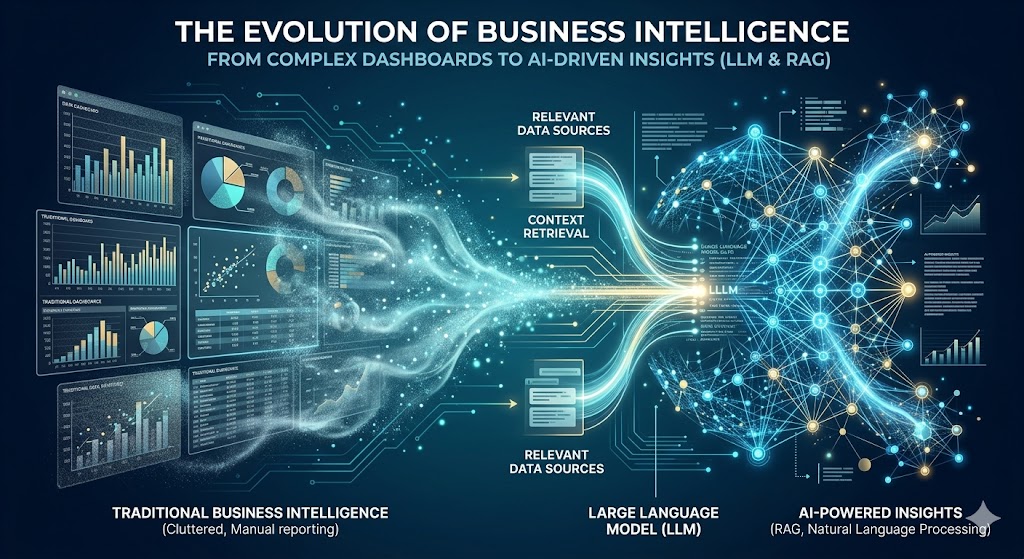
- LLMs (Large Language Models): the language model interprets the question, understands context, and generates a coherent response. It is the reasoning layer of the system.
- RAG (Retrieval-Augmented Generation): a generic LLM has no knowledge of a company’s internal data — and without that knowledge, it will fabricate answers, which is the last thing a business environment can afford. RAG solves this by acting as a fast, precise retrieval layer: before any response is generated, the system searches the organization’s own data sources — warehouses, databases, documents — and provides that context to the model. The result is an answer grounded in real, current, company-specific data.
Every response includes full traceability: which data was used, which filters were applied, and how the conclusion was reached. This is not a black box — it is an auditable system.
From reactive reporting to proactive intelligence
The shift from answering questions to anticipating them is where the real organizational value emerges.
A well-implemented system does not wait for someone to notice a problem. It detects that a region has been underperforming for three consecutive weeks, cross-references that signal with inventory levels and recent customer feedback, and delivers an alert before the issue appears in any scheduled report.
That is the difference between reactive BI — a tool that responds when asked — and proactive BI — a system that surfaces what matters before it becomes urgent. In operational terms, that difference can mean the gap between early intervention and crisis management.
Where this is already delivering results
Sales performance, without the Monday report cycle
Commercial teams ask directly: “Why did online channel sales decline this month versus last?” The system cross-references transaction data, seasonality patterns, and active campaigns, and returns a contextualized explanation — not just a number, but a diagnosis.
Customer feedback as a structured business signal
Reviews, support tickets, surveys — unstructured feedback that traditional dashboards were never designed to process. With RAG and LLMs, that data becomes actionable: “34% of incidents this week reference the same issue in the returns workflow.” That is the kind of signal that drives decisions.
Executive access to data without intermediaries
Leadership teams can query the state of the business directly, in natural language, without submitting a report request or waiting for a scheduled review. The data team is freed from fielding repetitive queries and can focus on higher-value analytical work.
Financial monitoring that does not wait for month-end
Integrated with accounting and treasury data, the system identifies budget deviations and unusual spending patterns proactively — with context about likely causes. The equivalent of a controller running continuous analysis, not a quarterly review.
Supply chain questions answered in real time
“Is there enough stock to meet projected Q3 demand across all distribution centers?” A question that previously required three systems, a manual export, and a cross-functional meeting now has an answer in seconds.
What a serious implementation actually requires
- Data quality is the foundation. RAG retrieves from what exists. If the underlying data is inconsistent or poorly structured, the outputs will reflect that. No AI layer compensates for bad data infrastructure.
- Access control must be enforced by design. The system must respect existing permission structures. A sales analyst should not be able to query payroll data simply by asking in natural language. This is a non-negotiable architectural requirement.
- Traceability is what makes it trustworthy. Every response must be auditable: what data was retrieved, what logic was applied, what was excluded. Without this, adoption will stall regardless of how accurate the answers are.
- Historical bias does not disappear with better models. If historical data reflects past decisions that were biased or incomplete, the system will reproduce those patterns. Oversight mechanisms need to be built in from the start, not retrofitted.
What this means for how organizations use data
Conversational BI is not a feature added on top of existing dashboards. It is a fundamentally different model for how an organization accesses and acts on its data.
Organizations that adopt this model early will have a structural advantage: decisions made faster, data teams focused on analysis rather than report delivery, and a data culture that is genuinely accessible — where any function can get meaningful answers without depending on a technical intermediary.
Dashboards will not disappear. But their role will evolve: from being the primary interface between people and data, to being one visualization layer within a system that is fundamentally conversational.
The relevant question is not whether an organization will move in this direction. It is whether that move will happen before or after the competition makes it first.
Is your organization evaluating how to approach this transition? The starting point is often closer than it appears. Get in touch.