
Data Governance Isn’t a Technology Problem (But Your Technology Needs to Know That)
We’ve seen this movie before. A company spends six figures on a shiny new data platform. Dashboards go live. Everyone’s excited for about three weeks. Then someone in a leadership meeting asks, “Where does this number come from?” and nobody has a confident answer. Slowly, quietly, people go back to their own spreadsheets. The platform becomes an expensive room nobody visits.
This isn’t a technology failure. The pipelines run fine. The dashboards render fine. What’s missing is trust — and trust isn’t something you install. It’s something you govern.
That’s the piece almost every organization skips: they pick the platform before they define who owns what, how quality gets measured, and who’s accountable when something breaks. Data governance sounds like a boring, bureaucratic afterthought, so it gets treated like one. But it’s actually the difference between a data platform people rely on and one they quietly work around.
So what is data governance, really?
Strip away the jargon and data governance is just this: a clear, agreed-upon way of deciding who’s responsible for your data, how good it needs to be, who’s allowed to see it, and what happens to it over time. It’s closer to a company’s financial controls than to an IT project. You wouldn’t let anyone touch the books without rules and accountability — the same logic applies to data, especially now that data feeds AI systems making real decisions.
The good news is you don’t have to invent this framework from scratch. It already exists, it’s been refined for years, and it’s vendor-neutral.
Enter DAMA and the DMBOK2
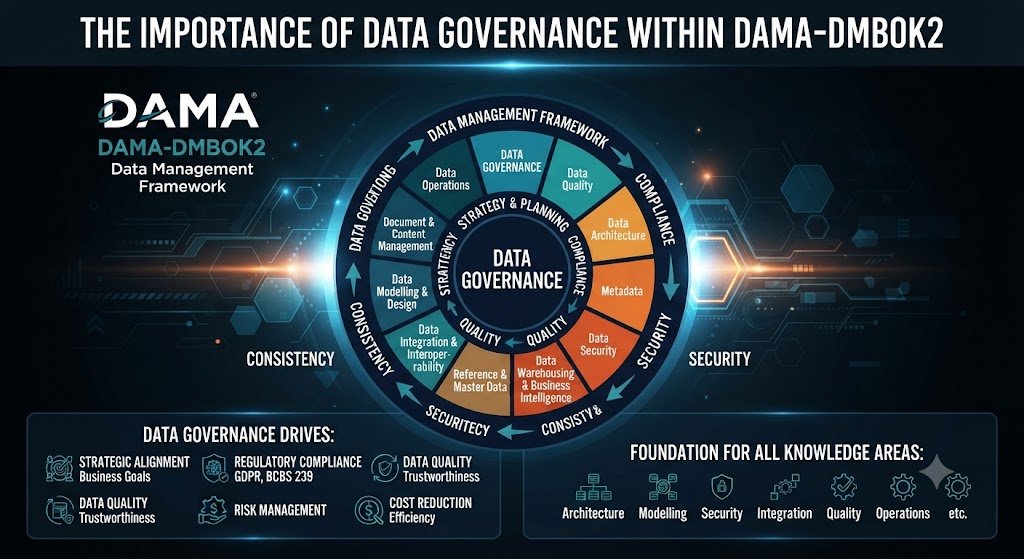
DAMA International is a global association focused entirely on data management, and their flagship reference is the DMBOK2 — the Data Management Body of Knowledge. Think of it as the accumulated playbook of what “doing data properly” actually involves, built by practitioners over decades, not by a software vendor trying to sell you a module.
The DMBOK2 breaks data management into 11 knowledge areas. You don’t need to memorize all of them, but a few matter enormously for any business leaning on data to make decisions:
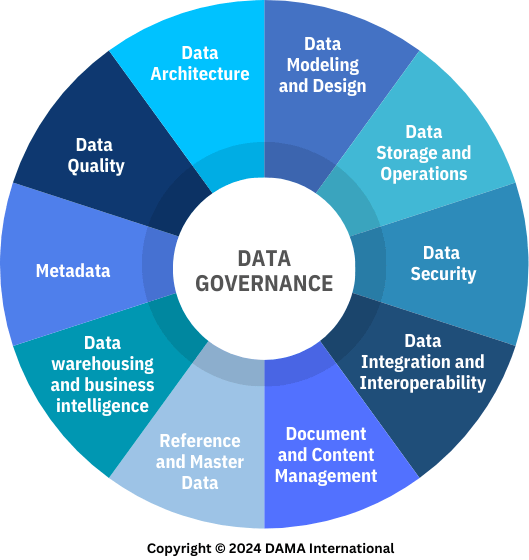
- Data Governance — the umbrella discipline: policies, roles, and accountability for everything else on this list.
- Data Quality — is the data actually accurate, complete, and timely, or just present?
- Data Security — who can see what, and can you prove it if asked?
- Data Architecture — is your data organized in a way that scales, or is it a pile of exceptions?
- Metadata Management — can people find out what a field actually means without asking around?
- Data Lifecycle — how data gets created, used, archived, and eventually retired.
Notice what’s missing from that list: any mention of a specific platform. That’s the point. DAMA defines the what — the disciplines every mature data organization needs — regardless of whether you run on Microsoft Fabric, Databricks, Snowflake, or a collection of Excel files held together with hope.
Where platforms like Fabric and Databricks actually fit in
This is where a lot of the confusion happens. Platforms get sold as if they are the governance strategy. They’re not. They’re the engine that makes a governance strategy executable — the how, not the what or the why.
Take Microsoft Fabric. It centralizes storage in something called OneLake, so instead of data scattered across a dozen disconnected systems, there’s one place it lives. It organizes that data through a “medallion” structure — raw data comes in as Bronze, gets cleaned into Silver, and becomes decision-ready Gold. Then a semantic layer connects it all to Power BI, so the numbers people see in a report trace back to something real. On top of that, Microsoft Purview brings cataloging, lineage, and access control — the tooling that lets you actually see who touched what and where a number came from.
Databricks follows a similar logic with its own vocabulary: a Lakehouse architecture that blends the flexibility of a data lake with the structure of a warehouse, the same Bronze/Silver/Gold pattern for progressively refining data, and Unity Catalog handling permissions, lineage, and auditing across the whole environment.
Different products, same underlying idea: good platforms give you the machinery to enforce governance — but only after you’ve decided what “good” looks like. A tool can log who accessed a file. It can’t decide who should be allowed to. That’s a governance decision, made by people, before a single line of configuration gets written.
What’s changed recently — and why it matters more now
Two things have shifted the ground under this conversation, and both point the same direction: governance is no longer optional, even for AI.
First, AI copilots and agents are now first-class citizens inside these platforms, and they need governing just like any other user — arguably more, since they can act quickly and at scale. Microsoft Purview now extends oversight to Copilots and agents operating inside Fabric: what prompts they’re fed, what they retain, what gets audited. Data-loss-prevention policies that used to focus on files and emails now reach into structured data — lakehouses, warehouses, semantic models — because a well-meaning AI assistant with the wrong permissions is a new kind of risk nobody had to think about five years ago.
Second, DAMA itself is evolving. Work on DMBOK 3.0 is underway, extending the framework to explicitly cover AI and machine learning data — training sets, model inputs, the provenance of data feeding automated decisions. The framework that started by organizing spreadsheets and warehouses is now catching up to a world where data quietly trains the systems making decisions on a company’s behalf.
The part that has nothing to do with software: roles
Here’s the piece that gets skipped most often, and it costs the most when it’s missing. DAMA is explicit that governance needs named humans attached to it, not just policies on a slide:
- Data Owner — accountable for a specific data domain and the decisions around it.
- Data Steward — manages day-to-day quality and definitions within that domain.
- Data Custodian — handles the technical storage, security, and access.
- Data Architect — designs how it all fits together so it scales.
Without these roles assigned to real people, even the best-configured platform ends up ownerless. And ownerless data platforms are exactly how you end up back at that leadership meeting, staring at a number nobody can explain.
Why this actually matters for the business, not just IT
When governance is done properly, the payoff isn’t abstract:
- Decisions get faster, because people trust the number in front of them instead of double-checking it against their own spreadsheet.
- Operations get leaner, because the same clean data feeds multiple processes instead of being rebuilt from scratch each time.
- Compliance risk drops, because you can actually show who accessed what and why — which matters a lot once regulators start asking about AI too.
- New opportunities open up, because a well-governed data foundation is what lets you experiment with AI and analytics without crossing your fingers.
- Customer experience improves, because consistent, trustworthy data is what personalization and service quality quietly depend on.
The bottom line
Microsoft Fabric, Databricks, or whatever platform ends up on your architecture diagram — none of it replaces the thinking DAMA and the DMBOK2 have been refining for years. The platform is the how. DAMA is the what and the why. Skip the second part, and the first part just becomes a very well-engineered way to store data nobody trusts.
If you’re evaluating a data platform right now, or you already have one and it’s not quite earning its keep, the honest first question usually isn’t “which tool?” It’s “who owns this, and what does good look like?” Get that right, and the technology stops being the hard part.
At Meraqi Data, we help organizations build data foundations that people actually trust — combining governance frameworks like DAMA with hands-on delivery on Microsoft Fabric and Databricks. If your data platform needs an owner as much as it needs an upgrade, let’s talk.