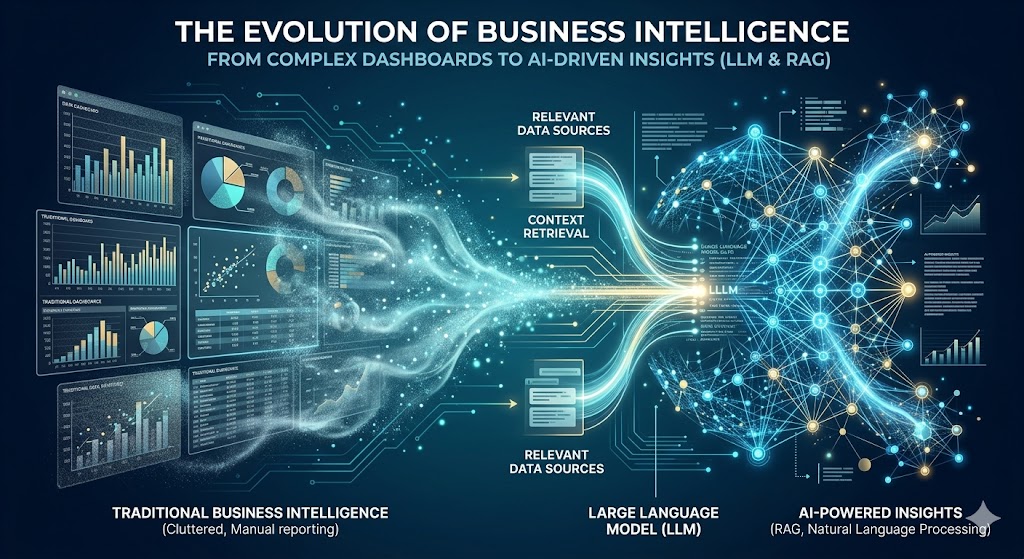

Almost every data team we talk to at Meraqi Data is dealing with some version of the same situation: a data warehouse here, a Databricks lakehouse there, an ERP living in the cloud, half a dozen pipelines nobody fully remembers the reason for, and now the added pressure to “put AI into” all of it. The result is almost never a lack of models or ambition. It’s that nobody fully trusts the data feeding those models.
Microsoft recently published a whitepaper on OneLake, the data layer underpinning Microsoft Fabric, that names this problem precisely and lays out a fairly honest framework for solving it. It’s worth unpacking, because it isn’t a features list — it’s an argument for why data architecture is a strategic decision again, not just an engineering concern.
The diagnosis: generative AI doesn’t forgive messy data
For years, organizations built siloed data systems, each optimized for one job: reporting here, machine learning there, operational analytics somewhere else. That worked, more or less, as long as each system stayed in its own lane. But AI agents don’t create new information — they synthesize what they find. If that foundation is fragmented or poorly governed, the result isn’t just a weak report, it’s a business decision built on sand.
Microsoft frames this around what it calls the “Frontier Firm”: organizations that embed AI into how they operate, rather than treating it as an isolated experiment. Getting there isn’t about having the most advanced model. It’s about having a trustworthy, accessible, governed data foundation that model can actually rely on without producing erratic results.
OneLake’s proposal: unify without moving
The core idea behind OneLake is simple to state and hard to execute: a single, logical data layer that connects everything — cloud, on-premises, multiple vendors — without forcing every piece of data to be physically moved to one place. Instead of the classic “ingest everything first, ask questions later” pattern, OneLake defaults to virtualization: data stays where it lives — in S3, in an on-premises database, in Snowflake or Databricks — and OneLake exposes it as if it lived in one namespace, using shortcuts (essentially symbolic links) and open table formats like Delta and Apache Iceberg.
When a physical copy is genuinely needed — for performance, for consistency — there’s zero-ETL mirroring, which synchronizes data without a team having to hand-maintain pipelines.
That’s not a minor technical detail. It shifts the default question from “how do I build a pipeline to bring this in?” to “can I just point to it?” And that reduces data duplication, speeds up onboarding new sources, and avoids the pipeline graveyard nobody dares to shut down.
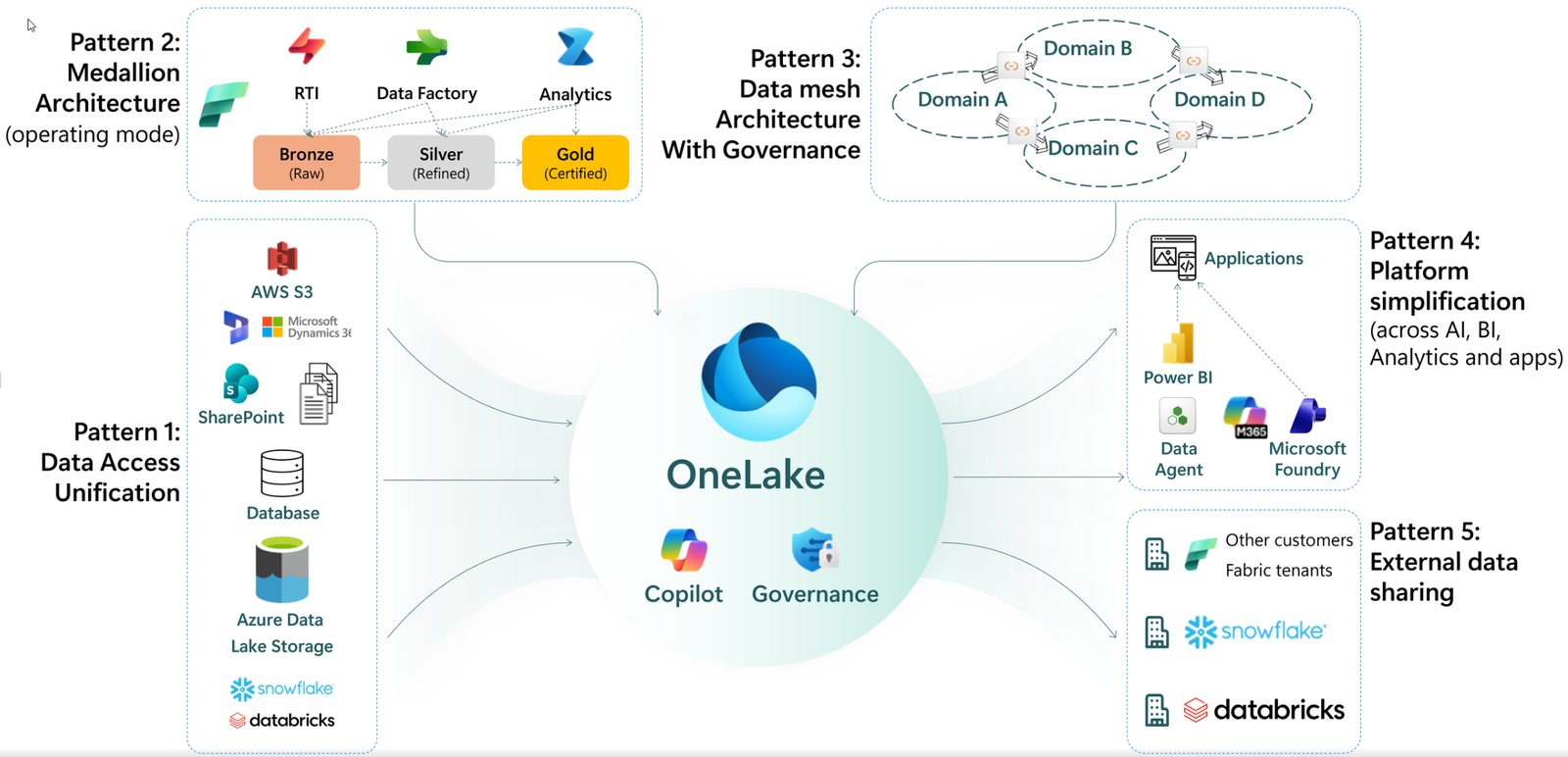
Five patterns, not a hundred options
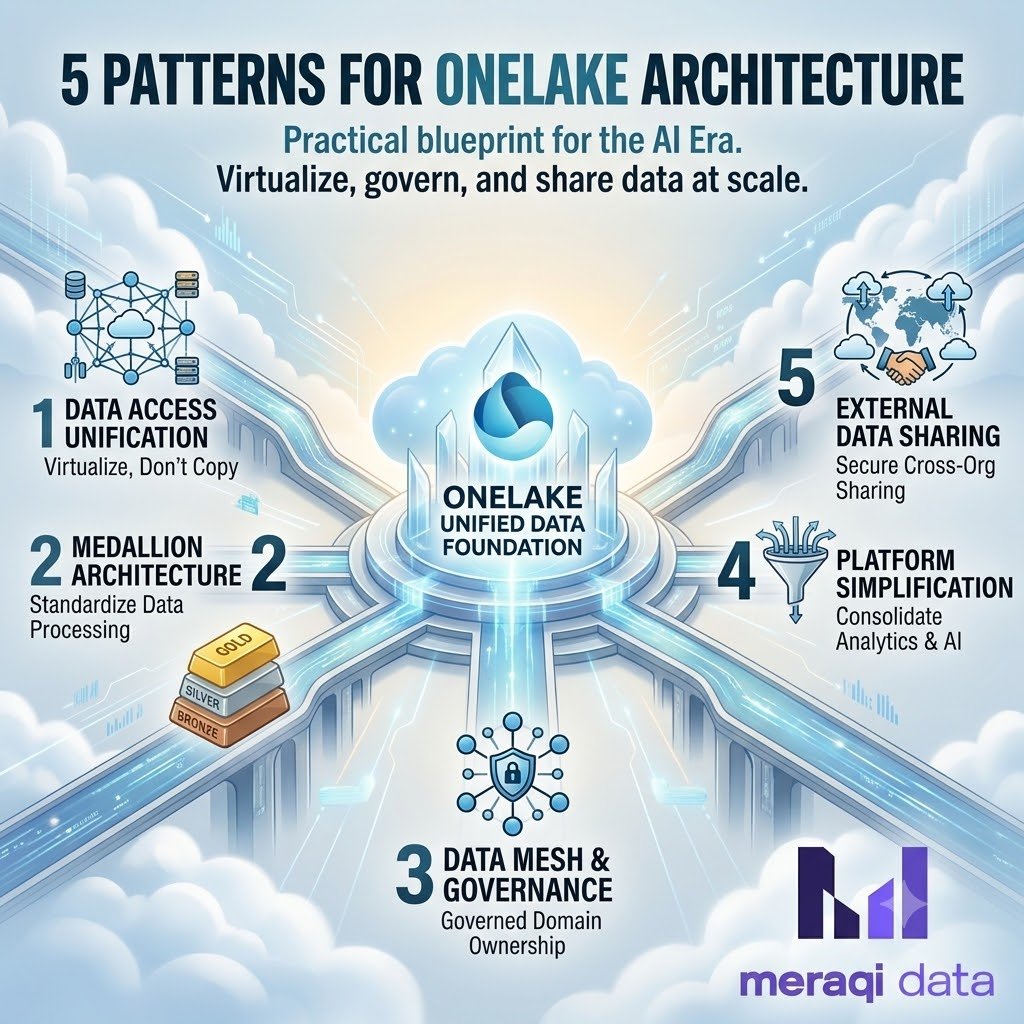
First, unified data access with minimal replication: virtualize instead of duplicate. Second, medallion architecture (bronze, silver, gold) as the standard operating model, so each layer has a clear purpose and every metric in production can be traced back to its source. Third, governed data mesh: business domains own their own data products, but on a shared, centrally governed foundation, instead of a central data team becoming the bottleneck. Fourth, platform simplification, consolidating analytics, data engineering, data science, and BI on a single governed copy instead of overlapping tools and licenses. Fifth, external data sharing, to collaborate with partners and customers without manual exports or losing control of who sees what.
No pattern excludes the others — a real organization usually combines two or three, depending on where the pain is sharpest. The whitepaper backs this up with real cases: a global healthcare distributor cut new-source onboarding time by roughly 40% by virtualizing instead of duplicating; a restaurant chain running more than 5,000 stores cut forecasting processing time by roughly 80% by replacing large ingestion pipelines with shortcuts. This isn’t slideware theory.
Why this matters to decision-makers, not just engineers
Here’s the point that often gets lost: how data is organized isn’t an isolated technical decision, it’s a business one. If AI is going to make — or help make — decisions on top of fragmented data, the risk isn’t just inefficiency, it’s exposure: sensitive information poorly governed, decisions based on stale or incomplete data, autonomous agents acting on data they shouldn’t have access to.
Governance, in this framework, isn’t a bolt-on module added at the end. It’s built into the data layer itself: row- and column-level access control, lineage, and audit, applied consistently regardless of which engine or application is consuming the data. That, ultimately, is the difference between an AI platform that builds trust and one that generates uncomfortable headlines.
Source: Microsoft Fabric Blog — OneLake architectural guidance: A practical blueprint for the AI Era
At Meraqi Data, we help organizations modernize and unify their data estate on Microsoft Fabric and OneLake — from virtualization and medallion architectures to federated, data-mesh style governance models — building the solid foundation any serious AI initiative needs. If you’re evaluating how to move your data platform toward this model, let’s talk.